Tuesday, February 27, 2007

Upgrading Blogger


I was finally able to figure out how to add some of the extras into the new Blogger. Here's some directions from a REALLY non-technical person~me.
This is what I did to add in the Cbox, Snippets, and other little do-dads on the sidebar. Go to the Dashboard. Click on the following tabs/buttons in this order: Template, Page Elements, Add & Arrange, Add a Page Element, then HTML/Java. This pops up a little window. From there I just copied and pasted the codes the other sites (Cbox, Christian Women Online, etc.) gave me for the items I wanted. I would paste one set of code, hit return a few times, then paste the next set of code, until I was done.
You could also probably redo, or make a new Page Element for each set of code, but putting them all into one worked for me. I choose what seemed easier at the time, although as I'm thinking of it, making a new Page Element for each would allow you to rearrange things easier later if you so choose. Good luck!

Tea Cozies


Think of it as a sweater for your teapot. A tea cozy is a wonderful item that really does help to keep the tea in your pot much warmer than it would be in an uncovered pot. Tea cozies come in a variety of styles, sizes, and fabrics so that there is a style and color to go with just about any tea set.

Some tea cozies are designed to slip over the entire pot, like this red Chinese style as well as the black embroidered cozy in the top picture. This style covers everything and is removed when you wish to pour a cup of tea.

The other common style is like the pink and white cozy shown above. It has two panels with open sides, joining at the bottom in a elastic band, and at the top where it is gathered and tied on with a ribbon. This style remains on the pot while pouring as the spout is uncovered. This was the first cozy I owned and I have enjoyed it for many years. The only problem I have with this style is that often teapot spouts drip and the tea ends up on the cozy itself. (Yes, you can use a Dripper Sipper to avoid this, but I don't usually remember to grab one.)

How should you choose a tea cozy? Decide which style you think you would prefer. Maybe you would like the slip-on model because you would like to show your teapot's designs. Maybe the tie-on would help to unify an unmatched tea set.

I think it is overall, just a matter of personal preference. I would suggest that you make sure the cozy is well-padded, as this adds to its ability to insulate your tea. I would also suggest that you take your teapot with you when shopping for a cozy, as different ones will not fit certain pots. It should be snug, but not tight. My cozies fit most of my teapots, but not all. I have a few teapots that are quite tall and some that are too fat. All three of these cozies fit my everyday teapots just perfectly.

All this talk about tea is making me thirsty. Guess I better go put the kettle on! Won't you come join me?

Monday, February 26, 2007

Tea Table Video


Here's a You Tube video that Joanna mentioned in the Comments on Silver Tea sets. It's a 1946 video on how to "properly" set your tea table. Oh my! Whilst I miss many old-fashioned manners, I'm not sure I've ever been this...precise...about setting a table. I much prefer beautiful and relaxed, to stiff and perfect.

Poor June. I'm glad she had someone there to help her!

Note: Umm, some You Tube viewers do not use any etiquette when leaving comments. Profanity warning for the YT Comment section! The video, of course, is just fine!

Calling Card Information

I've (finally) put together some of the information I've found on calling cards. There's a lot of information out there and it's taken awhile to put it together in a more readable form. I've just listed the links out in the open. Maybe I'll get around to "hiding" them later. Not enough time now!

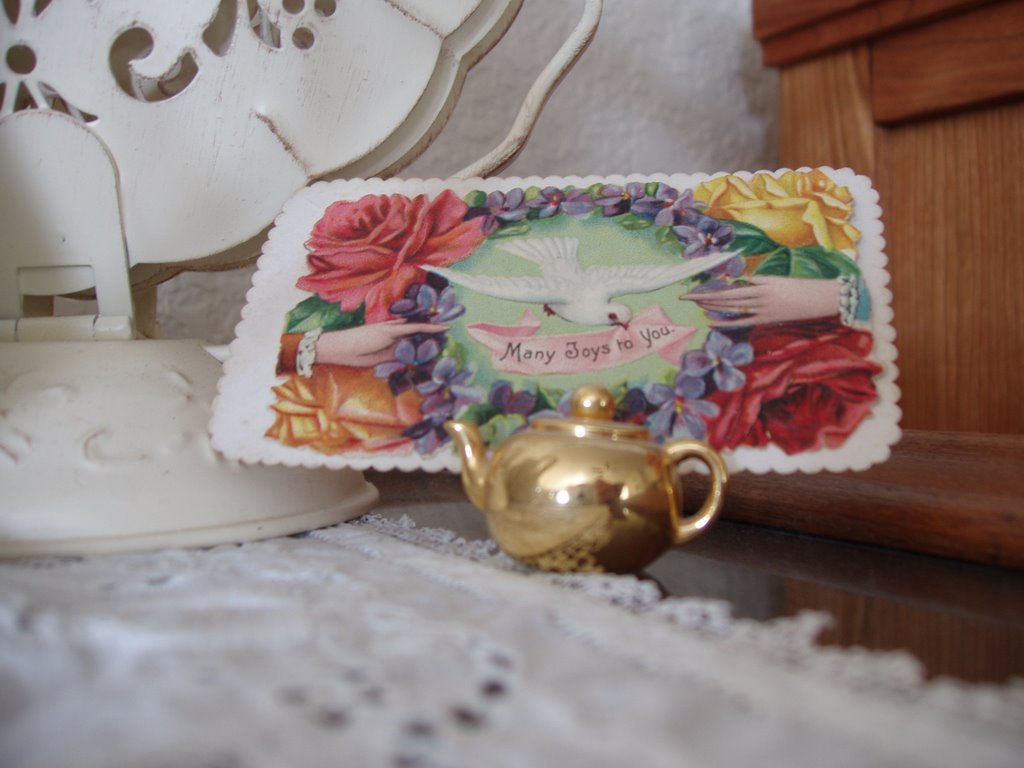
Some of the pictures are of the three calling cards Sweetheart gave my for Valentines Day to add to my collection. He's been apparently saving these. They are some of the nicest ones with my favorite flowers. They are called "hidden name" cards as the names are printed on the white cards and hidden behind the colorful scrap pictures. He's been giving these to me for years, so I have amassed quite a collection! They are lovely, much prettier than our boring business cards of today.

As you can see, they came in different shapes and sizes. Many of the same pictures and symbols appear in varying forms on the cards. Most have hands for friendship, hearts for love, and doves for peace. The flowers are often roses, whose Victorian meanings vary with their color, pansies/heartease for thoughts, and forget-me-nots whose name says it all! Anchors may be found symbolizing steadfastness, and interestingly enough, the Cross.

Preprinted messages may be found wishing the receiver "Kind Thoughts", "Best Wishes","Kind Regards", "Faithful & True", and "God's Blessing Upon You". Some even managed little rhymes like "May ev'ry blessing God can give Bring peace around you while you live!" and "The trees of the forest may perish, The flowers of the valley decay, But let our friendship last forever, While all earthly things pass away" and "While this short greeting I indite, I pray God grant you prospects bright". That's a lot to get on a little card!

Sweetheart has blessed me with so many of these little treasures. Most of them appear to be from the 1870s-1900's, although I do have a few monochrome cards that appear to be from the 1860's. I hope to find an old friendship album someday to place them in. Right now I have them tucked all around the house. They can be found in a silver tray on the table in the living room, nestled amongst teacups and saucers in the dining room, under the glass of my tea cart, and in the frame of my bedroom mirror. They are small, but brighten wherever they may be found. (I believe he's purchased most of them on Ebay. Ruby Lane also sells them sometimes as well.)

So, go get your cup of tea and settle in for a read. Here's some articles and links you may enjoy:

An Article on Victorian Calling Cards, Friendship Cards, Advertising Calling Cards, Surnames & Customs
by Debra Clifford, Town Historian of Ancestorville


"Each family member had their own card; parents, brothers, sisters, older children, newlyweds. Cards were also printed announcing the joyful birth of a child. Calling cards were first introduced in France in the early 1800's and caught on through Europe and America as an important social craze. The height of the popularity of the calling card era coincides with the reign of Queen Victoria, Queen of England from 1837-1901, which is commonly referred to as the "Victorian era". Queen Victoria truly lived her life in celebrity status, influencing both a generation at home and "across the pond."

The Victorian era had its own distinct style, language, culture, literature, arts, architecture, artifacts, traditions, beliefs, values, and behaviors that contributed to the influence on all aspects and classes of American 19th c. culture. Role, status, and social class was very important in describing the interactions of individuals and social etiquette, thus filtering down to all classes.

The use of calling cards was perceived as "high style", carried by "well-to-do" ladies and gentleman who made a point to call on friends and family on specified days of the week or month. Also known as "visiting cards", each one is different and beautiful. Most are unique and one of a kind, with early examples of stone lithography printing, hand tinting, the handwritten word, die cut papers and cardstock, unique fonts and typefaces indicative of the era, and exhibiting unusual paper delineations.

Below we see a "hidden name" card, whereby a fancy "scrap" (as in "scrapbook", another Victorian era craze) was lifted to reveal the caller's hidden name. We find both fancy male and female cards in our travels. The card below has the Victorian symbols of a woman's hand and flowers, to convey the message of friendship. Hearts, doves, birds, scrolls, urns, cupids, forget me nots, roses, and women's hands were common calling card themes.

The term "Calling" or the verb "to call" was a common Victorian term for making a visit. The card was left at the door, or in the front parlor in a silver urn, basket or "Card Receiver". These receivers were placed to hold cards for the family, whether they be home or not. Cards left reminded the family of who had called, thus requiring a visit in return. This served as a mode of communication, to receive messages, greetings and announcements of who was in town, births, deaths, sympathy announcements, engagements, and general social events. As a form of communication, the calling card in itself was considered a very important message. It was also an exciting day in the social life of a young Victorian era family member to be granted their first calling card.

Proper manners, and acceptable social etiquette were paramount to one’s social standing in a community, and "Calling" or "Visiting" was the most important leisure activity of the period. Calling card etiquette itself dictated the clothing, length of stay, time of visit and how long to stay. Women were the more frequent callers, this being an important ritual of daily life of upper class women. It was simply the job of the woman of the house to keep the family in good social standing in the larger social world.

There were strict rules on how a woman was to behave, with men's calling habits showing less strict rules or ceremony. A call may only last fifteen minutes, with several calls being made in a single afternoon. It is noted that the folding of card corners communicated different meanings, such as an upper left corner fold might say congratulations and a lower right fold might signify a goodbye."

From:
http://ancestorville.com/victoriancallingcards.html

Background Information on Calling

"Calling was a highly ritualized activity in the Victorian Era. Calling was a way to preserve friendships and establish new ones. Etiquette books were full of suggestions on how to leave a card, how to behave if invited to see the mistresses of the house, and how to host a caller at one’s own house. Calling, the Victorians believed, was one way to attain elegance and establish one’s social standing. It was a way for them to demonstrate to themselves and others their manners and good breeding.

The calling card played a major role in the calling ritual. The design of card and typeface chosen said a lot about a woman. Plain white or off-white stock cards engraved with a name in confident type were admired while a card decorated with gaudy monochromatic flowers denoted a woman of lower rank (and taste.) Once calling was established between two individuals of equal rank, the ritual continued until one party either moved away or died. Among those of unequal rank, trading calls could be halted when the higher ranking individual ignored the lower ranking woman.

For the most part cards were to be left in person. It was considered poor taste to send a card with a second party or a servant. When paying a call, one would hand a card to the servant who answered the door. The servant would either tell the visitor that the mistress was not at home or, would take the card to the mistress for further instruction. Upon receiving the card, the mistress would either tell the servant to send the person away (a sign that one had fallen out of the mistresses favor), or come down in person to visit with the caller.

When a person was invited to call at a certain time, like tea time, it was considered very rude to refuse. However, if one did have to refuse an invitation a call was required a day or two after the event. A good hostess would make her guests comfortable with engaging conversation and would provide “conversation starters” in the form of books, needlework, or photographs so that her guests might converse with each other on common ground. Again, etiquette books were full of suggestions for proper behavior:
Etiquette for the hostess: You should be dressed at least a half hour before your guests are to arrive. To come in, flushed from a hurried toilette, to meet your first callers, is unbecoming as well as rude….As each visitor arrives, rise, and advance part of the way to meet her….If appropriate, introduce your guests to each other…always introduce the younger one to the elder…It is a good plan, to have books and pictures on the center table, and scattered about your parlors. You must, of course, converse with each caller, but many will remain in the room for a long time, and these trifles are excellent pastime, and serve as subjects for conversation….A well-bred lady, who is receiving several visitors at a time, pays equal attention to all, and attempts, as much as possible, to generalize the conversation, turning to all in succession.
Etiquette for the caller: After you have received an invitation to a party, call within a week or fortnight after the evening, whether you have accepted or declined the invitation…When the servant answers your ring, hand in your card….When the servant announces you, enter the parlor…Greet the hostess and sit down quietly, do not walk about the parlor, examining the ornaments and pictures, it is ill-bred….Never sit gazing curiously around the room when paying a call, as if taking a mental inventory of the furniture. It is excessively rude….instead make polite and agreeable conversation with the hostess and other guests.

For the Victorians, the ritual of calling was an integral part of good society. While we have lost the subtle nuances of the ritual today, the calling card, to some degree, still exists. Business cards are our calling cards and telephones are our calls. The secretary or answering machine is the servant who announces the caller, giving us the opportunity to accept or claim that we are unavailable."

From:
http://www.capemaymac.org/Physick-Estate/interpretive-notes/interpretive-notes-77-1-2001.htm


Calling Cards - A Study in Victorian Decorum By Walter & Kimberley Lemiski

"The tradition of leaving one’s calling or visiting card goes back some 300 years. It was considered the duty of the women-folk to pay the social calls, such as calls of condolence, congratulation, and calls on the ill. “Occasions when other calls are obligatory. After a wedding breakfast, a luncheon, a dinner, a card party, or any evening entertainment to which one has been invited, a call should be made after the event whether one has accepted or not.” - the Delineator, c.1880. Often times the ladies would leave their husband’s cards along with their own. In a Delineator magazine of that era it is stated that: “It is generally understood that women leave their husband’s cards. The custom is for a married woman calling formally on another married woman to leave one of her own and two of her husband’s cards, one of his being for the hostess, the other for her husband.”

The arbiters of good taste in Victorian times set out the proper forms of conduct down to the last “t”. One of the most fascinating of traditions was that of the “at home”. This was a set visiting time on weekday afternoons, generally between 2 and 4 p.m. Each household would let it be known on which days their own “at homes” were to be held. (The hostesses could indicate their own “at home” days by having a day of the week engraved on the lower left of their calling or visiting cards.) The proper amount of time spent in visiting at such a function was between twenty to thirty minutes. Tea would be served along with the appropriate cakes. The hostess would have taken care not to serve too elaborate a presentation so as to appear to be aspiring beyond one’s station. The more skilful at this social game could fit in two or three visits in an afternoon. And of course one must return a visit within a suitable time despite how distasteful this duty might be it would otherwise be considered a social gaffe. The Delineator also suggests appropriate frequency of calls: “As a rule, it is impossible to do more than make a single call a year on acquaintances in large cities, and this is supposed to be sufficient.”

In the middle part of the 19th century hand-written cards were often made to order by experts in the art of calligraphy. These experts in penmanship might be considered the lineal descendants of the old “letter writers” of the 16th century. It was these chirographers (artists of pen decoration) who would ply their trade in the streets, parks, and fairs, quickly tossing off a dozen or so cards for a very reasonable sum. Their script had the appearance of copperplate printing with its elaborate ornamental style of lettering and flourishes of fanciful birds, ribbons, swans, quill pens, and flowers. [see card 1] For the more affluent, handpainted cards were produced by professional artists. And of course, amateurs, those scores of young ladies at home, would often strive to create their own tastefully personalized cards. Calling cards besides always displaying the name of the donor would often times also contain an appropriate phrase or a short, often sentimental, verse.

When we are old we’ll smile and say
We had no cares in childhood’s day
But we’ll be wrong.
Twill not be true.
I’ve this much care.
I care for you.
[American verse c.1880]

The writers for Godey’s magazine, that magazine of fashion and good taste, in the 1870’s even went so far as to prescribe the appropriate details on calling cards: “ Its texture should be fine; its engraving, a plain script; its size not too large or small to attract attention in either way.” While it was deemed appropriate to present small white cards for formal calls, for less formal calls, or for those in less fastidious circles, coloured ones could be utilized. These more elaborately embellished ones might have been Decalcomanias (c. 1880) - in more simple terms decals. According to Webster’s Dictionary: Decalcomania - the art or process of transferring pictures and designs from specially prepared paper (as to glass). To those in the know a calling card was truly a mark of one’s breeding. From the 1879 volume entitled Social Etiquette of New York one learns that: “The friendliest sentiments are expressed by a timely card. It tells its little story of fondness or of indifference, according to the promptness and the method of its arrival. It announces a friend, and it says adieu. It congratulates delicately, but unmistakably, and it is the brief bearer of tidings which a volume could explain with no more clearness.”

The vast majority of calling cards available were those created commercially by lithography. Up until the 1870’s, the lithography was generally monochrome - that is of a single coloured ink. Some cards can be obtained that were done in black ink then labouriously hand painted. By the third quarter of the 19th century card manufacturers were experimenting more and more with different papers and effects - embossed cards, die cut edges, coloured cards, striped papers, linens, marbleised papers, and most importantly of all multiple colours.

The advent of chromolithography started slowly enough through the 70’s with innovative printers attempting the combination of two or three colours at a time. By the 1880’s and 1890’s the art of chromolithography had reached its golden age. Magnificent combinations of fifteen to twenty colours created wondrous pictures with fabulous colour contrast and depth.

The Crown Card Company of Cadiz, Ohio (self-proclaimed “dealers in Fashionable Visiting Cards”) produced calling cards through the 1880’s. In their “New Sample Book” produced circa 1885, the consumer was offered a wide variety of cards ranging in very reasonable prices from 12 for 15 cents through to 30 for 10 cents — all in assorted designs. Of course one purchased cards according to one’s means and much more expensive cards could also be acquired. The following ad appeared in Harper’s Bazaar in the late 1860’s: “Visiting cards for the coming season are of unglazed card board, large and almost square. Tinted cards, especially buff, are fashionable. The lettering is in old English text, or in script. The expense of fifty cards is $3.50.”

One of the most intriguing developments in visiting cards in the 1880’s were the aptly named “hidden name” cards. In these creations, colourful die cut paper scraps were applied on the central portion of the card to conceal the giver’s name. These delightfully served to add a little spice of mystery for the recipient.

The paper scraps used standardized iconography of friendship such as extended or clasped hands, birds, floral flourishes or nature scenes. As in other Victorian decorative arts the creators of calling cards made ever increasingly elaborate offerings as the century progressed. The card pictured as No. 9 exemplifies this Victorian flair for the elaborate. Not only is the calling card a “hidden name” one, but the card has die cut edges, embossed paper and best of all instead of the paper scrap simply being applied over the individual’s name, this card features it applied on a die cut envelop whose decorated flap lifts to reveal the die cut name card enclosed within!

As with the giving of flowers, with leaving cards there was a special significance for the manner in which the card was left. One could bend a corner of the card to add a special message — the rather complicated “language of cards.” In his Learning How to Behave, c. 1880, Arthur M. Schlesinger wrote: “Quite apart from such details as the correct size and typography was the difficult symbolism involved in bending the edges. Turning down the upper right-hand corner signified a personal visit; the upper left corner, congratulations; the lower right-hand corner, adieu; the lower left corner, condolence; the entire left end, a call on the whole family. This practice, introduced from abroad shortly after the Civil War, commended itself to city dwellers who had little time or inclination for individual visits and yet did not wish to feel negligent of their duties.... Despite its conveniences, the custom was becoming passe by the 1890s. The sign language proved too great a tax on the human intelligence.”

Naturally, appropriate receptacles had to be devised for the proceedings. Calling card receivers were created out of glass, wood, and, most notably, silver. Typical early card receivers were approximately six inches in diameter, and were often mounted on a pedestal. That giant of silver plate manufacturers, the Meriden Britannia Company, produced but four different designs in 1861. Twenty-five years later, in 1886, Meriden Britannia was able to offer fifty-eight card receivers and six card tables! Decorative motifs on these receivers could include butterflies, insects, owls, elephants, children, cherubs, swans, frogs, peacocks, storks, fruit, squirrels, cats, dogs, deer, flowers, fantastical foliage. Some card trays even incorporated art glass vases in their designs. By 1890 the peak of formal elaboration had been reached. The next couple of decades saw the return to less ostentatious creations.

Calling cards can afford an interesting historical perspective of the development of printing through the 19th century. Directly associated with these innovations is also the progression of Victorian decorative style. We can as well catch a glimpse of the unique social customs of that day and age with their regimented sense of decorum. As with other ephemeral items one marvels that such beautiful little momentos has managed to survive some one hundred to one hundred and fifty years and now can provide us with so much delight and joy.

From:
http://www.antique67.com/articles.php?article=56


More Links:


I've love to institute an "At Home" day for callers to come and visit and stay for tea. Wouldn't you? Although, fifteen minutes does not seem long enough!

Sunday, February 18, 2007

"Upgraded Blog"


I've been happily toodleling (SP?) around Blogland with my Old Blogger Blog. Until today. Blogger decided to no longer allow me to live in the past. In order to access the Blog I had to upgrade to the New Blogger. Sigh. Oh well, you get what you pay for, right Sweetheart?

So, at this point it's switched over, but several items disappeared entirely, including the Chatbox and my cute little sidebar buttons. I'll try to figure out how to add those later this week. I'm open to suggestions!

Also, I've noticed a few of you sweet ladies are linking here lately. I love that! I'd like to return the favor. Please leave a comment with your website and I'll get you added to the list as I continue to fiddle with the site this week.

I'm not sure when I'll get to it all as Pumpkin has decided he no longer needs two naps a day. This has greatly reduced Mommy's ability to work on projects during the day (including blogging) as I often am napping at the same time as his afternoon nap. It'll all work out. (Right about the time the new baby arrives!)


Note: The picture has no obvious link to this posting. It's just a picture of the mantel in the Family Room. The Chinese scroll has Philippians 4:7 on it.

"And the peace of God, which transcends all understanding, will guard your hearts and your minds in Christ Jesus."

Hmm, maybe is does relate as I need a reminder of that verse often...

(NIV Copyright © 1973, 1978, 1984 by International Bible Society)

More Information on Silver Teapots

Here's some tips I found for cleaning the inside of a silver teapot.


* Pour vinegar into the teapot. Let it soak for several hours/overnight. Rinse, and wash by hand with regular dish soap.

* Put a denture tablet in the teapot (Efferdent). Fill the pot with boiling water. Let soak. Some sites say a few minutes, some overnight. Rinse, and wash by hand with regular dish soap.

* Put a teaspoon of borax powder in the pot. Fill the pot with boiling water. Let soak. (I have no idea how long to let it soak!) Rinse, and wash by hand with regular dish soap.


I am by no means a silver expert! I just looked around for information. Hope this helps. May I suggest starting with short soaking periods first to see if they are affective before leaving something in overnight? You may also wish to test some of these ideas on silver pieces that may not have as much value in case something goes amiss.


Do you have an idea that's worked for you? Please comment! Also, letme know if you try any of these suggestions and how they work for you. As I mentioned in a previous post, I usually just use my silver pieces for decoration, so I have not needed to clean out the insides, just polish the outsides.

Thursday, February 15, 2007

More Valentines

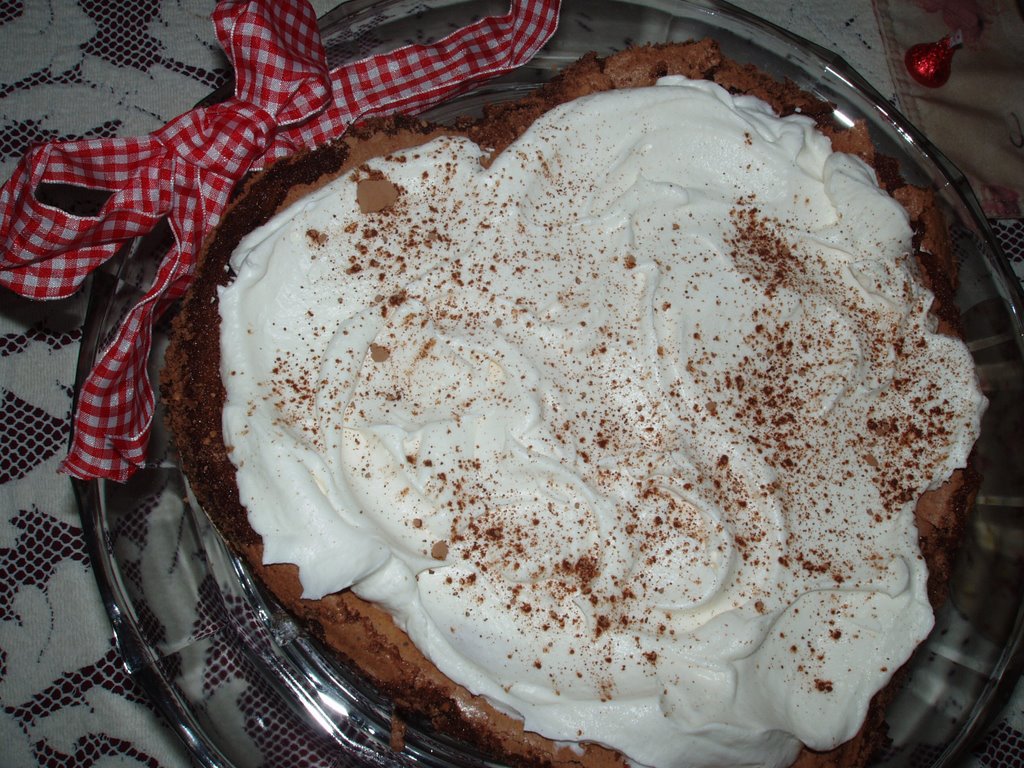
Chocolate Cloud Cake
The Table by Candlelight

Living Room


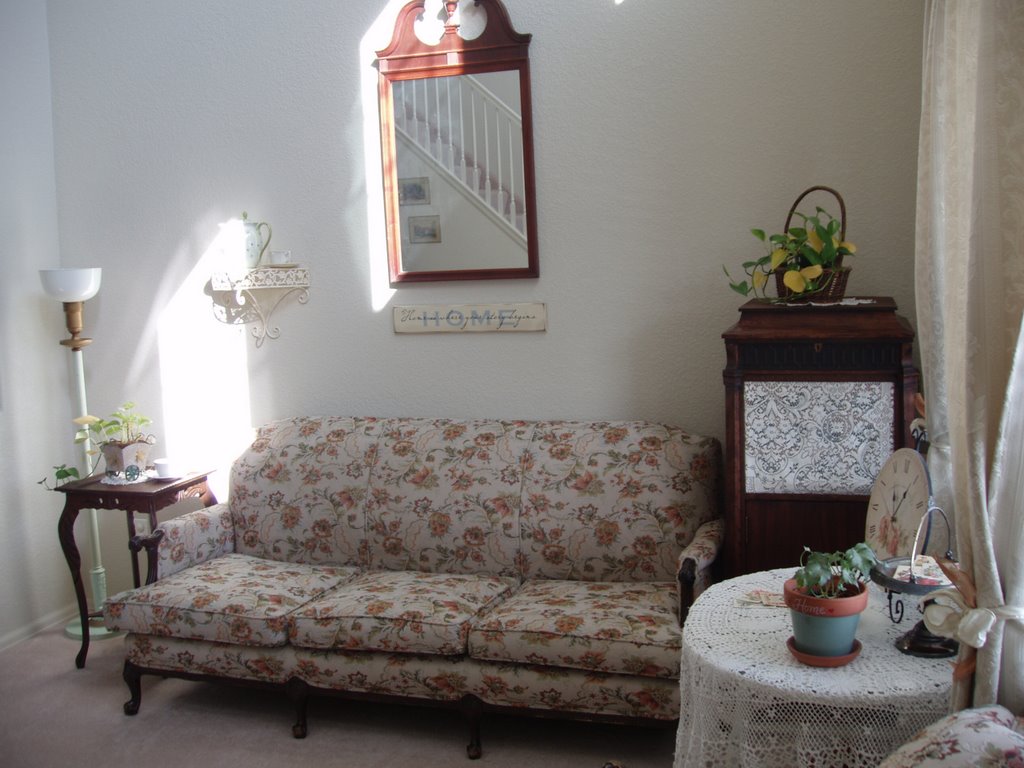
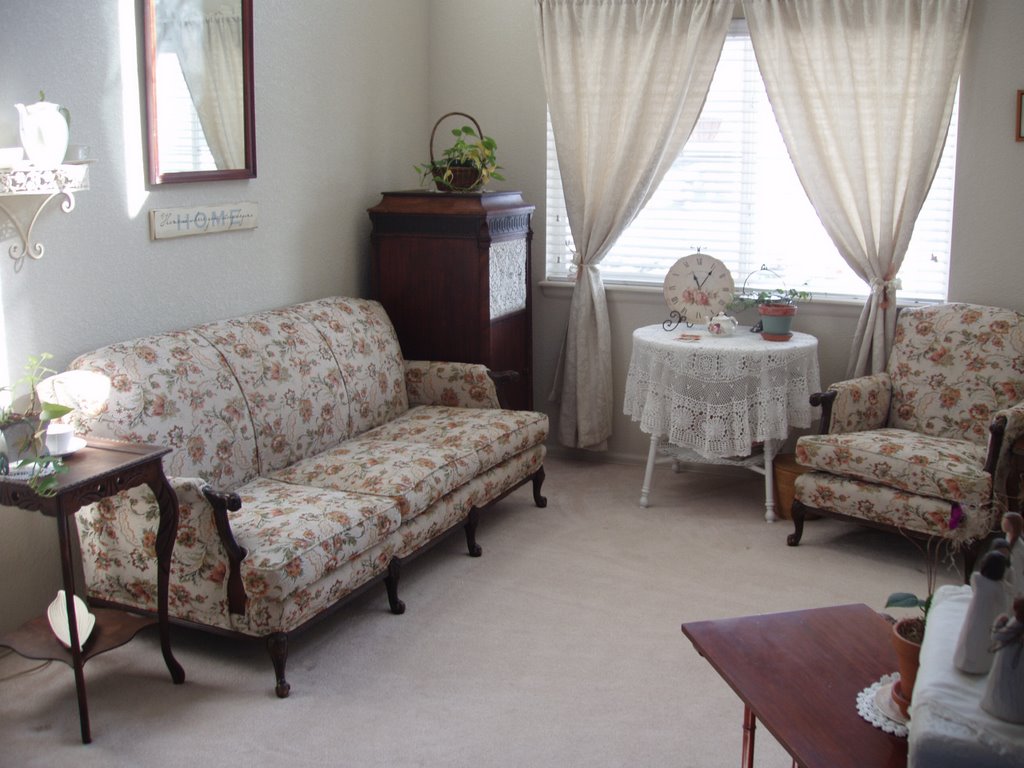
Here's some pictures of our Living Room. You can see part of it in the picture from Valentines Day, so I thought I'd post these. I rearranged the whole room after we took down the mammoth Christmas tree. It really opened up the room and made it feel larger.

The couch, chairs, mirror, and one table had been my grandparents'. They purchased everything just after my grandfather returned from WWII. The tall, wooden table was a friend's who gave it to us because it didn't match anything in her home.
In the corner is our Edison. It's like a phonograph, but was patented by Thomas Edison and works in a slightly different manner. We have a bunch of the records, but they are pretty scratched up, so we rarely play it. We store dvds in the bottom cabinet. The front panel was missing when we bought in, so I place a panel of lace in the opening to finish it off.
The white wicker table we actually bought at an auction a few years back. The crochet tablecloth was a thrift store find. The clock was a lovely homewarming gift from my sister years ago. The small teapot had been my grandmother's. The silver stand is filled with some of my antique calling cards. (There's a picture of that close-up a few posts down.)
Sweetheart added to my calling card collection yesterday for Valentines Day. I'll be posting pictures of those when I get my post done on the history & symbolism of calling cards. The things laying on the cloth are cards and an antique Valentine with a little red-headed boy.

It's like having a parlor. This is the room you enter when you walk in the front door. However, unlike most parlors, Abner the Airedale has claimed the couch as his bed and can often be found there after eight p.m.

Silver Tea Pots

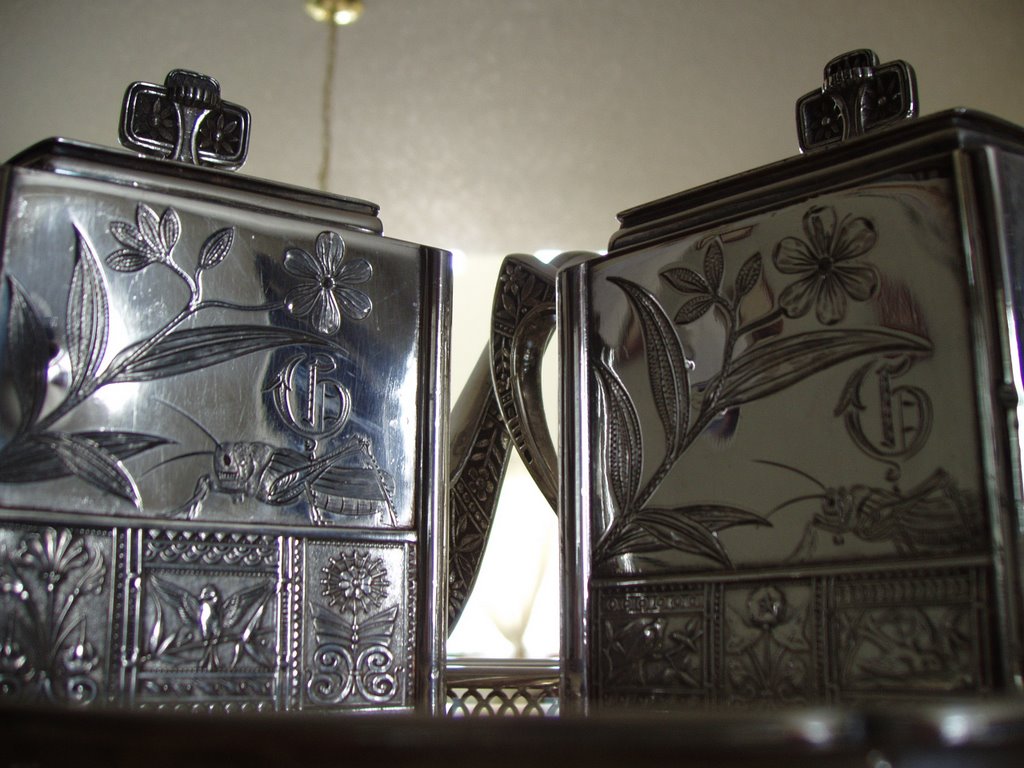
Since Joanna and I have been discussing this on the cbox I thought I'd post some pictures of one of my silver set. This is a Pairpoint teapot and tea caddy/biscuit holder. (I've seen these listed both ways.)
I was given the teapot for doing the food for a friend's wedding. She'd asked another friend to pick a gift for me that she thought I'd like. This is what Gwen found. Apparently, due to the cost it became a dear gift from both friends. The caddy appeared months later as a Christmas gift from my father. Gwen had seen it when she bought the teapot and had called him to see if he'd like her to get the caddy as well. I'm so glad they did!
The engraving is incredible right down to the "G" monogram, which happens to be the first letter of both my maiden and married names. These are two of my special treasures. In fact, I filled them with flowers and had them on the cake table at my wedding.
However, there is one problem. Like all silver, they tarnish. A lot! I'd put them away for awhile because they so desperately needed polishing and I wasn't getting around to it. I bought some Weiman Royal Silver Polish the other evening and disposable gloves at Target. I chose the Weiman brand because it was not filled with harsh chemicals.
Yesterday, I put on the gloves, grabbed a bunch of rags and got to work. This was by far the best polish I've used as far a harshness and smell. (There is always a bit of a sulfur smell from the tarnish itself.) It wasn't bad at all.
It didn't take too long and the results were definitely worth it. I now have the set displayed on my tea cart, but will move it to the bookcase once some books are out of the way.
Photographing silver is never easy as it reflects everything, especially the flash. Pardon the not-so-great pictures. Now Joanna, it's your turn! (I'd had some other pictures that should some of the teapot designs better, but alas, Blogger isn't playing nice.)

Before:

After:

Wednesday, February 14, 2007

Happy Valentines Day!


I've been busy today getting things ready for when Sweetheart comes home. The bread is rising, the cake is cooling, the wife is cleaning! I love Valentines Day & romance everyday.


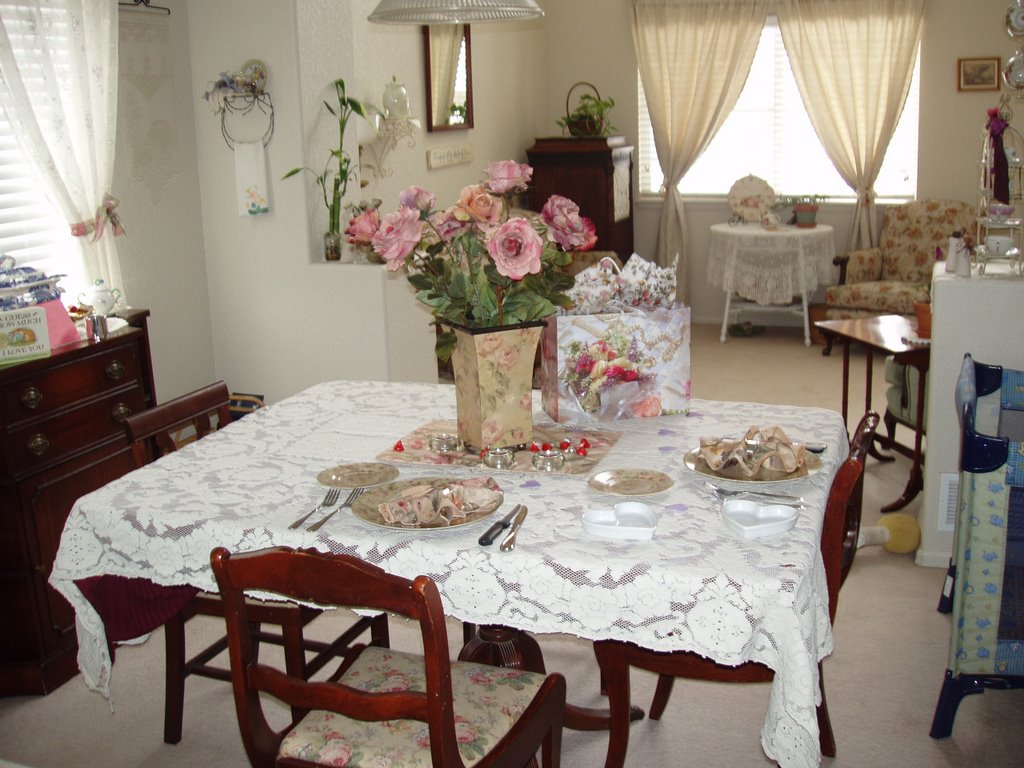
I've got the table set. Ah, romance. Is that a pack & play next to the table? You bet! I'm suprised I didn't get the highchair on the other side in as well. Reality & romance...We'll make it work. I'd have done more pictures, but the card was full & the battery low.

The Menu

Salad
Focaccia Bread with Oil & Vinegar for Dipping
London Broil (Barbqueing in the snow, what fun!)
Potatoes
Chocolate Cloud Cake (I'll try to get a picture of this. It's a flourless chocolate cake infused with orange and topped with fresh whipped cream. MMMM!)


****
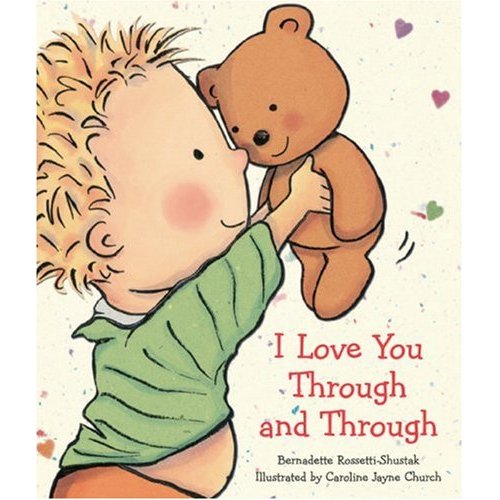
I got this cute book for Pumpkin's Valentine: I Love You Through & Through. The boy in the book look's a lot like Pumpkin!


And finally, here's something wonderful from the pastor's wife of the church I grew up in back in Phoenix.

ABC’s of a Good Marriage

By Sue Wilson
It seems like nearly everyone in America has been touched by divorce in some way – either in our own lives or in the lives of those we care about. At times it feels like divorce is surrounding us on all sides. There seems to be conflicting and confusing information about just exactly how high divorce rates are in America.

Much of that information isn’t reliable, and some of it is downright false according to a report by TruthOrFiction.com, a website that works to sniff out the truth. According to their research, the rumor that half of American marriages end in divorce is simply that – a rumor.

There really has been no comprehensive reliable study done on this subject. However, researcher George Barna’s most recent attempt to attain some accurate statistics regarding divorce showed that the number of marriages in America that end in divorce is closer to one-fourth than one-half. Even so, I think we would all agree that divorce is a devastation that we need to guard against in our own marriages.

My husband and I have been married to each other for 38 years and we are often asked to share the secret of our marital longevity. In considering how to best do that, I came up with the following “ABC’s of a Good Marriage,” which offer some practical things we’ve learned over the years.

Admire your spouse.
Everyone wants to be admired by those they love. Let your spouse know that you approve of who they are and what they do.

Be flexible.
Sometimes life throws us curves. Learn how to go with the flow and not let the unexpected put a strain on your relationship.

Commit and communicate.
Make a decision to stay married. Learn how to talk about what you’re feeling and ask questions about what you don’t understand. Most spouses are not mind-readers!

Don’t dwell on the past.
You can’t change it, so forget it. “Forget about what’s happened, don’t keep going over old history.” (Isaiah 43:18)

Explore new ways to do things.
Is your sexual relationship with your spouse stuck in a rut? In today’s world there are a ton of Christian resources for improvement. Here’s a few suggestions: Sheet Music by Kevin Lehman; Intimate Issues by Lorraine Pintus and Linda Dillow; and Sexual Skills for the Christian Husband (available online at www.christian-sex.net) by Robert Irwin. (Be aware that this is a very graphic and direct book that some people may find offensive). Even good marriages need to relight the flame occasionally!

Forgive.
Accept the fact that your spouse isn’t perfect, can’t meet all your needs, and can’t do everything right all the time. This is a good time to apply the Golden Rule: Treat others as you want to be treated. (This is biblical by the way. See Matthew 7:12 and Luke 6:31). If you want your flaws to be overlooked, you need to be willing to overlook the flaws of your spouse.

Give up and give in.
Life does not revolve around you and it can’t always be your way. Being insistent, stubborn or domineering does not create an atmosphere for love to grow. Sometimes the best choice for a strong marriage is to do it your spouse’s way even when you don’t agree.

Handle failures with care.
Your spouse can and will do just about anything with your support. If you are determined to say, “I told you so!” when the dream flops, you’ll soon find that the dreams have either stopped or are not being shared with you.

Inspire your spouse.
The more you inspire, encourage and support, the more you’ll find your advice and opinions being regarded with respect. Marriage is a partnership where each partner’s job is to help the other be as successful as possible.

Just drop it!
It’s not worth winning the argument if it costs you your marriage. Besides, there’s always the possibility that you could be wrong and your spouse could be right.

Keep your criticism to yourself.
The only thing worse than being critical of your spouse at home is doing it in public! That’s the absolute best way to make your spouse feel threatened and unloved. It's a sure way to drive a wedge in your relationship.

Love your spouse even when you don’t like him/her very much.
Don’t waste your time being angry over unmet expectations. Love is a choice, not a feeling.

Make time to be with your spouse.
Opportunities to be together rarely just happen. Sometimes they have to be scheduled. When our children were small, my husband and I made a commitment to go on a “date” every Friday. That time was sacred because we both knew it might be our only chance during the whole week to reconnect with each other.

Never say never.
God has a sense of humor. The minute you say never is the minute something will prove you wrong.

Own your mistakes.
We all make mistakes. Don’t blame your spouse for yours.

Pray.
By now you’ve probably learned that the “happily ever after” you heard about in fairy tales is just that –- a fairy tale! Chances are your spouse doesn’t have a clue what your needs are or how to meet them. That’s why it’s important to remember that only God can meet your every need.

Quit blaming your spouse.
No marriage is perfect. It isn’t your spouse’s fault any more than it’s yours.

Relax.
Life is too short to be stressed out all the time. Has being worried or stressed ever helped make anything better? God is in control; He doesn’t need your help.

Save some energy for your spouse.
Even on the days when the kids have run you ragged or your job has sapped the life out of you, it’s important to find a little something inside for the one you love. If you don’t, chances are he/she will start looking for someone who will.

Trust.
I once heard some good advice at a women’s conference. The speaker said, “Sometimes we just need to get out of the way and let God have a clear shot at our husbands!” That goes for wives too! God is in the life-changing business. Let Him do His job.

Understand that men and women don’t think alike.
God made us different -- there must be a reason.

View your spouse through God’s eyes.
Jesus died for all of us. That means your spouse’s imperfections are covered just as thoroughly as yours are.

Wake up and see what you’ve got.
There’s a long line of people out there who would just love to have the spouse you’ve got, imperfections and all!

X out the disappointments.
When something doesn’t go your way, draw an “x” through it and move on!

Yank the temptations.
Few people go out looking for an affair. Don’t put yourself in situations where Satan can deceive you; he doesn’t play fair.

Zero in on your spouse’s strengths.
Remember what first attracted you. Focus on what he/she does well. Dwell on the good stuff.

These ABC’s can’t guarantee a perfect marriage, but hopefully you’ll find some tools to help you get through the difficult times. Even after 38 years, my husband and I are still working on most of these. Marriage is hard work, but if you are willing to do what it takes I think you’ll find it’s worth it. Maybe you’ll escape being another statistic in the research on divorce.

From:
http://www.ccvonline.com/Arena/default.aspx?Page=2233&ArticleGuid=6ec15ca0-b79a-46da-8d3a-1d7ac942b8d0&CountRead=True&Score=10

Sunday, February 11, 2007

New Tea Book?

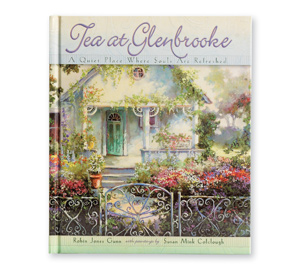
I was visiting the Bigelow Tea Website when I came across this book I've never seen before, Tea at Glenbrooke. The cover is lovely, not of course that we would judge a book by that, and Robin Jones Gunn is a delightful author. It appears to have been published in 2001, but I've not seen it in any stores or tearooms.

Have any of you read this book yet?
There are quite a few other fun things on their website (http://www.bigelowtea.com). How football and tea mix, though, I'd rather not find out. Must have been a Super Bowl thing.
Of course, I must admit to visiting Harney & Sons Fine Teas website as well. (http://www.harney.com)


Isn't this teacup lovely? It's $6.00 price makes it even nicer, though it does not appear to have a saucer in the pictures. I like saucers.


I'll be making a pot of this tea tomorrow in honor of the week of L*O*V*E*. I love Valentines Day. I thought I'd make my valentines this year, but it somehow didn't happen and I'm hoping to just get cards out in the mail in the morning. Maybe addressing the final few with a cup of Valentines Blend (chocolate & rose) Tea will help.


Friday, February 09, 2007

Canister/Biscuit Jar

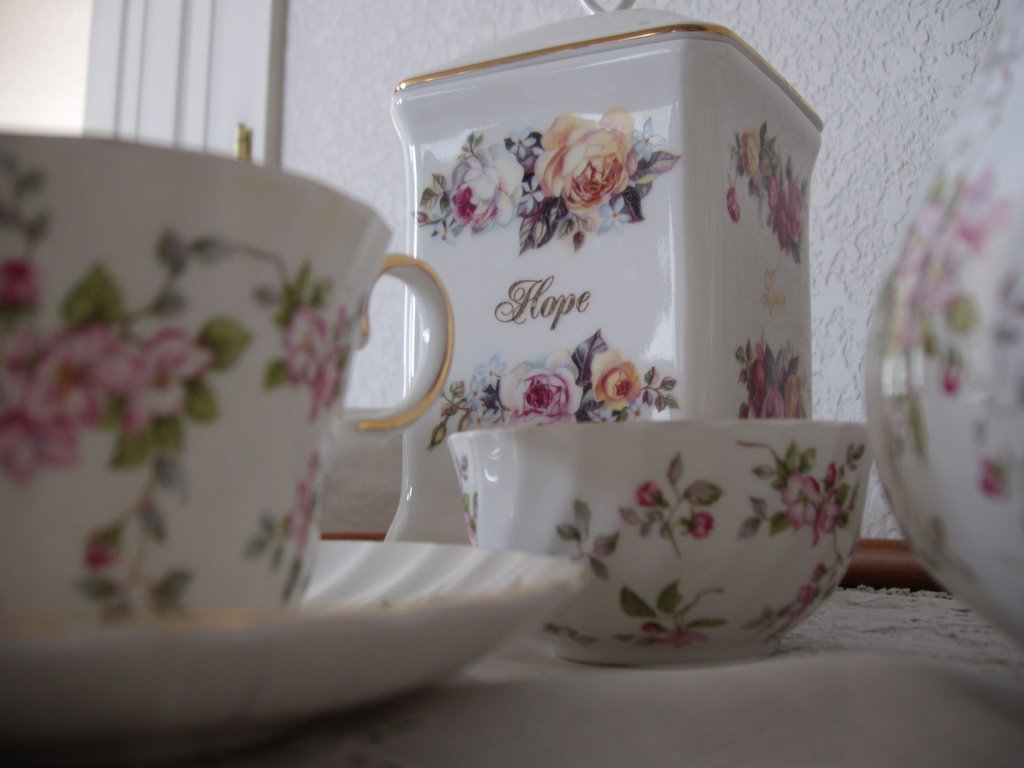
I love this Sandy Lynam Clough canister. I usually keep special tea biscuits/cookies in it. Each side is different. The four sides read Faith, Hope, Love, and Joy. This is a part of her "Blessings Among the Roses" set. There are four teacups that match as well as a teapot, creamer, sugar and dessert plate.
Alas, all I have at this point is the canister. It would be too costly to get the entire set. Of course, I just remembered I still have credit at the shop from the last job I did there. Hmmm...
Now, this is interesting. I was going to add a link to her site, www.sandyclough.com and so I clicked on through and discovered she is now selling some of her designs through www.christianbook.com for the best prices I've ever seen. Wow. Maybe I could collect a few more pieces after all. Of course, I don't need any more teacups. Really. I'll keep telling myself that!

Shamrocks

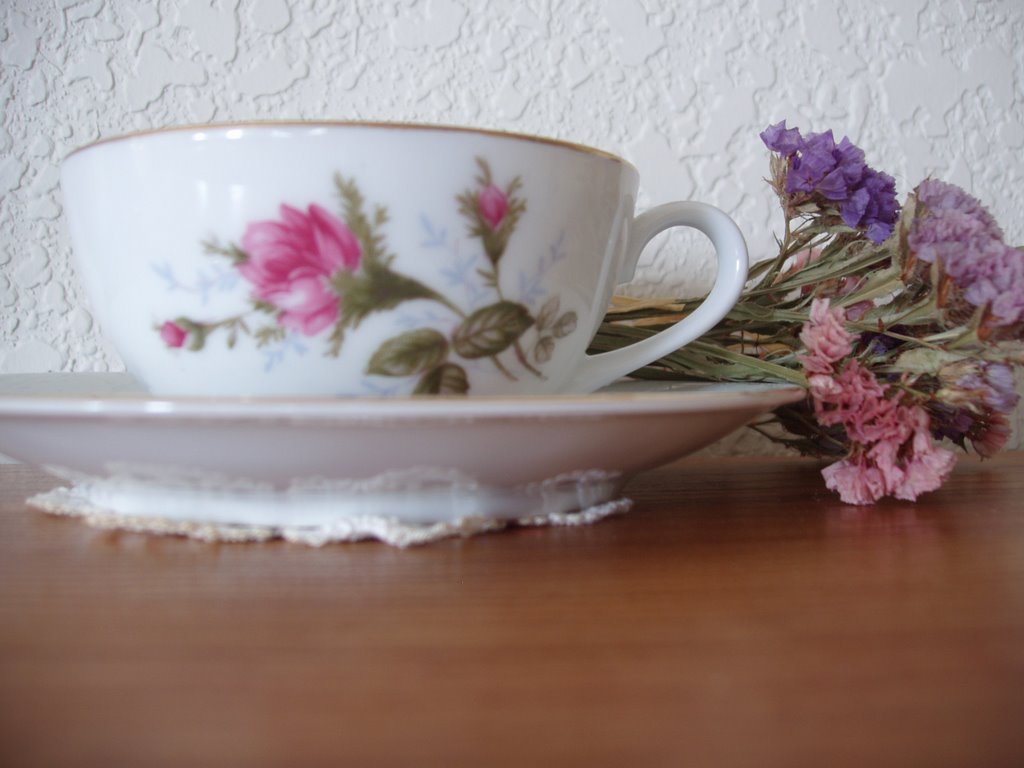
Moss Rose

Calling Cards


Wednesday, February 07, 2007

Tea Cart


My Birthday present last spring was a beautiful cherry tea cart. I've never seen one with such beautiful lines. I enjoy changing the displays seasonally. In the fall I place my Lusterware peach and blue set. At Christmas I had it set with Christmas china and poinsettas.

After I put the Christma decorations away I put my Rose Tree Chintz china out. It looked a little pink for January, but now is all set for Valentines Day. Won't you come join me for tea?

Sunday, February 04, 2007

My Own Meme

I've had fun doing the memes I've found that I decided to make my own. Please, join the fun. Consider yourself tagged. Please link back here if you do this.
These are a Few of My Favorite Things…

A Authors
Classic: Jane Austen, Charles Dickens, LM Montgomery, Francis Hodgson Burnett
Contemporary: Randy Alcorn

B Books
Classic Childrens' Books: Anne of Green Gables; LM Montgomery, Little Women; Louisa May Alcott, The Little Princess & The Secret Garden; Francis Hodson Burnett
Classics for Adults: any Jane Austen, Charles Dickens, or CS Lewis
Contemporary: Safely Home; Randy Alcorn


C Coffee
Pumpkin Spice Lattes

D Dessert

Chocolate Cloud Cake, a flourless chocolate cake flavored with Grand Manier and topped with fresh whipping cream.

E Elegant Object You Own
My Great-Grandmother’s Cameo Necklace

F Flowers
Tie: Pansies and Roses, although Lavender is nice too!

G Guests for Tea
I’ve love to have tea with Jane Austen. Of course, I'd have to invite Kelli and Mrs. Wilt to join us!

H Home
Our current home is my favorite. I love the layout, the big front porch and my garden.

I Inspirational Authors

Randy Alcorn, Dee Henderson, T. Davis Bunn, Jan Karon

J Jane Austen book
Sense & Sensibility

K Kitchen Gadget
My Bosch mixer is so great.

L Laundry Help
We keep two baskets in the closet and sort our clothes into lights and darks as we go. Saves time when I do the wash. I then put all my folded clothes in one basket and Sweetheart's in the other as they come out of the dryer. It makes putting things away easier, as well.

M Musical
Oklahoma!

N Naptime
I love naptime on a rainy afternoon when I’ll snuggle into bed with a book and a cup of tea, read & relax awhile then drift off to sleep.

O Organizing Tip
Always clean up the kitchen before you go to bed.

P Pride & Prejudice Character
I figured asking which movie version had already been done enough!
In the 2005 version I like Jane the best. In the A&E version I like Elizabeth.

Q Quote
"You can never get a cup of tea large enough or a book long enough to suit me." ~C.S. Lewis

R Recipe
Currently, the Ginger Bear Cookies are at the top of my list. In fact, I may go make some as soon as I post this!

S Scent
Lavender

T Tea
Ashby’s Earl Grey

U Underwater Creature
I think Sea Anenomes are really neat!

V Voyage You’ve Taken
My trips to China have been the best voyages.

W Water Feature; Lake, Creek, Ocean, etc.
Clear Lake by South Mineral Campground just outside of Silverton, Colorado.

X X-tra Special Treat for Yourself
Soaking in a bubble bath with a good book, chocolate, and a cup of tea by candlelight.

Y Thing About YOU!
My smile, though not in pictures where it often looks forced.

Z Zoo Animal
Flamingoes

Thursday, February 01, 2007

If Teacups Could Talk

I have a lot of books on tea. A lot. (Just ask Sweetheart!) But my favorite book of all is If Teacups Could Talk by Emilie Barnes. I have read Emilie's books on home management and hospitality since I was living in a dorm room. Of course, mine was one of the only dorm rooms with its own tea set...
As soon as I saw ITCT with the beautiful illustrations by Sandy Lynam Clough I bought it. I've never regretted that purchase. I've enjoyed spending hours pouring over this delightful book while drinking my cuppa and planning when I could have my next tea.
While I was pregnant with Pumpkin I worked at The Tea Rose in Arvada, Colorado, which is a delightful tea-themed gift store. We sold ITCT all the time. Whenever someone would ask us what tea book to buy it was what we would recommend. From tea planning tips to easy, but delightful recipes, ITCT has it all.
If you buy only one tea book for you, or a friend this is the book to get!

LinkWithin

Blog Widget by LinkWithin